atty — Architecture
- atty — Architecture
- Module layout
- Comptime composition
- Data flow
- Why a low-level PTY dance?
- Termios raw mode
- Signal handling
- Ghost-text rendering
- Line-state model
- OSC 133 prompt markers (auto-detect)
- Subprocess-context tracking (auto-detect)
- Config resolution
- Keymap
- Status bar + incognito
- Pick list (multi-row ghost suggestions)
- Concurrency
- Future work
Module layout
src/
├── main.zig                  # CLI entry: arg parsing → proxy.run
├── root.zig                  # library entry: re-exports for `@import("atty")`
├── config.def.zig            # committed template — atty's reference config
├── config.zig                # user overrides (gitignored; seeded from .def on first build)
├── config_resolver.zig       # merges user_config with defaults via @hasDecl
├── defaults.zig              # atty-shipped default for every overridable knob
├── proxy.zig                 # poll() loop, signal handling, ghost-text scheduling
├── module.zig                # shared types: Action, Context, Error
├── dispatch.zig              # Dispatcher(modules) — comptime walker
├── keymap.zig                # Action enum + Binding struct for bindings[]
├── style.zig                 # Style struct + presets (ghost overlay, warnings, …)
├── pty.zig                   # posix_openpt / grantpt / unlockpt / fork+exec child
├── terminal.zig              # cfmakeraw-equivalent termios guard for our stdin
├── mouse.zig                 # SGR-1006 mouse-event parser + DECSET sequences
├── line_state.zig            # best-effort user-input buffer model
├── ansi.zig                  # SGR/CSI helpers + escape stripping
├── ghost.zig                 # ghost-text overlay state machine
├── modules/
│   ├── atuin.zig             # async Atuin module (suggest + record + sync)
│   ├── guardrail.zig         # dangerous-command confirmation module
│   ├── history.zig           # shell-native ~/.bash_history fallback module
│   ├── llm/                  # AI mode (Alt+A / Alt+S / inline + overlay chat)
│   ├── mouse_links/          # left-click on a path → `$EDITOR +LINE 'path'`
│   ├── mouse_urls/           # left-click on a URL → opener, gated by trust posture
│   └── security_guard/       # pre-Enter Tier-1 + UDS client to atty-guard sidecar
├── unit_tests.zig            # entry for `zig build test`
└── test/
    ├── integration.zig       # PTY round-trip tests (`zig build itest`)
    └── e2e/                  # scripted PTY scenarios + VT grid diff (`zig build e2e`)
Comptime composition
The dispatch loop is unrolled at compile time:
inline for (config.modules, 0..) |M, i| {
    if (comptime @hasDecl(M, "onInput")) {
        switch (try M.onInput(rts[i], ctx, current)) {
            .forward => {},
            .swallow => return .swallow,
            .replace => |b| { current = b; final_action = .{ .replace = b }; },
        }
    }
}
Each iteration is a separate, type-checked code path. Modules that
don’t declare onInput contribute zero bytes to this function.
Removing a module from config.modules eliminates every call path
through that module — verify with nm zig-out/bin/atty | grep modulename.
The Runtimes tuple is a heterogeneous tuple of pointers to each
module’s runtime, built via std.meta.Tuple. Pointers (rather than
values) for two reasons:
- Stable heap addresses let modules hold long-lived self-references
(the Atuin worker thread captures
*Shared). - Zig’s strict “no comptime-var pointer at runtime” check
fires when dispatch takes
&tuple[i]on a value tuple. Pointers sidestep this.
attachAll heap-allocates one Runtime per module at startup;
detachAll frees them in order on shutdown.
Data flow
                            ┌───────────────────────┐
       (user keyboard) ───▶ │ stdin (poll fd 0)     │
                            └───────────────────────┘
                                       │
                                       ▼
                    ┌──────────────────────────────────────┐
                    │  Keymap match (bindings[])            │
                    │  ───────────────────────              │
                    │  bytes-equal? → run Action:           │
                    │    ghost_accept → replace bytes with  │
                    │                   current suggestion  │
                    └──────────────────────────────────────┘
                                       │
                                       ▼
                            line_state.applyInput
                                       │
                                       ▼
                    ┌──────────────────────────────────────┐
                    │  Dispatcher.dispatchInput             │
                    │  ───────────────────────              │
                    │  guardrail.onInput → atuin.onInput    │
                    │  short-circuits on .swallow           │
                    └──────────────────────────────────────┘
                                       │
              ┌────────────────────────┴───────────────────────┐
              │ Action.forward / .replace                       │
              │   → write(master, …)                            │
              │ Action.swallow                                  │
              │   → do nothing (keystroke eaten)                │
              └─────────────────────────────────────────────────┘
                                       │
                                       ▼
                    ┌──────────────────────────────────────┐
                    │  if Enter committed a certain line   │
                    │  dispatchLineCommit(line)            │
                    │  (atuin records, history appends, …) │
                    └──────────────────────────────────────┘

      (shell stdout) ◀────  ┌──────────────────────────┐ ◀── read(master)
                            │ dispatchOutput            │
                            │ (observe-only; no mutation)
                            └──────────────────────────┘
                                       │
                                       ▼
                            write(stdout, output)
                                       │
                                       ▼
                            renderGhost() — gatherGhostText:
                            walks config.modules front-to-back,
                            first non-null suggestion wins
                            (or clear if every module returned null)

      (poll() timeout) ───▶ dispatchTick(elapsed_ms)
                            (TTL expiry, status indicators)
Why a low-level PTY dance?
We use posix_openpt(3) → grantpt(3) → unlockpt(3) → ptsname(3)
instead of openpty(3) / forkpty(3) from libutil. Three reasons:
- Smaller link surface. Only libc, no libutil.
- Explicit lifecycle. We own the master fd from the moment it’s
allocated; the slave fd lives only inside the child between
setsid()/ioctl(TIOCSCTTY)anddup2(). - No BSD-isms.
openptyallocates a name buffer for the caller; we don’t need that.
Termios raw mode
We put our stdin into raw mode but leave the child’s terminal
alone — the kernel sets up a fresh termios on the slave, and the
shell configures it however it wants (canonical for prompts, raw for
vim, etc.).
| Group | Flag | Off because… |
|---|---|---|
| iflag | IGNBRK/BRKINT | Don’t translate breaks; the shell sees raw bytes. |
| iflag | ICRNL/INLCR | CR ≠ LF. Conflating them breaks heredocs and editors. |
| iflag | IXON | No XON/XOFF flow control on a local TTY. |
| oflag | OPOST | No \n → \r\n on our own writes; we already emit \r\n. |
| lflag | ECHO/ECHONL | The shell echoes; doubling would show every key twice. |
| lflag | ICANON | We want per-keystroke wakeups, not line buffering. |
| lflag | ISIG | Ctrl-C is a literal 0x03 to forward; not our SIGINT. |
| cflag | CSIZE=CS8 | 8-bit clean. |
| cc | VMIN=1 VTIME=0 | read() blocks until ≥1 byte; no inter-byte timer. |
A defer raw.deinit() restores the original termios on every exit
path including panics — critical, because a crashed atty must not
leave the user’s terminal echoless.
Signal handling
We use the self-pipe trick: signal handlers do one
async-signal-safe write(pipe, &sig, 1). The main loop reads from the
pipe inside poll() and dispatches:
- SIGWINCH — query our stdout’s winsize via
TIOCGWINSZ, propagate to the master viaTIOCSWINSZ. The kernel auto-delivers SIGWINCH to the foreground process group inside the PTY, so the shell and any full-screen apps (vim, less) all see the resize. - SIGCHLD —
waitpid(child, …, WNOHANG)to detect child exit and drop out of the loop.
Portable (signalfd is Linux-only) and obviously correct.
Ghost-text rendering
Constraints:
- The shell owns the line; we must never leave dim bytes that the shell can scribble over.
- The cursor is always controlled by the shell.
Strategy: before every byte we write to stdout (whether forwarding shell output OR the user typing), we clear any existing overlay first. After every dispatch where the suggestion might have changed, we render-or-clear the current best suggestion.
Ghost.show is idempotent: if the same text is already rendered we
emit nothing — that matters because the proxy re-renders on every
tick (default 100 ms), and naive re-paints would flicker.
| Sequence | Meaning |
|---|---|
| ESC 7 | DECSC — save cursor + attributes |
| ESC 8 | DECRC — restore cursor + attributes |
| CSI 2 m | SGR dim (≈ 50% intensity in most terminals) |
| CSI 3 m | SGR italic (optional via ghost.style.italic) |
| CSI 38;5;n m | SGR 256-colour fg (optional via ghost.style.fg) |
| CSI 0 m | SGR reset |
| CSI K | EL — erase to end of line |
The exact SGR bytes emitted are driven by config.ghost.style — an
atty.Style value. atty.Style is the shared styling primitive used
by every visible element (ghost overlay, guardrail warning banner,
future status indicators). Fields: bold, dim, italic,
underline, reverse, optional 256-colour fg/bg. Named
presets are in atty.style.presets; module configs accept their
own style fields so a user can pull a consistent palette across
the whole proxy. Default matches fish + zsh-autosuggestions: dim only.
Line-state model
Approximates what the user has typed, not what the shell currently thinks the line is. We handle:
- Printable ASCII → append
- 0x7F / 0x08 → backspace
- 0x15 → kill line
- 0x17 → kill previous word
- 0x03 / 0x04 → clear
- 0x0D / 0x0A → submit + clear
Anything else (arrow keys, ESC sequences, tab, ctrl-R, vi mode) flips
an uncertain flag. While uncertain, providers suppress ghost text
until the next newline. Stale suggestions are worse than no
suggestions — this is the safety invariant.
Recovery: uncertain clears on Enter, Ctrl-C, Ctrl-D, Ctrl-G (line
reset), Ctrl-U (kill line), Ctrl-W (kill word, when it empties the
buffer), and on Backspace that brings the buffer to empty. The
principle: when the buffer is empty we can’t be wrong about its
content, so we lift the gate. Arrow-key history navigation does not
self-recover — the user has to explicitly clear the line.
OSC 133 prompt markers (auto-detect)
The keystroke model above is blind to anything the shell puts on
the prompt line — history recall (Up-arrow), tab completion, paste
expansion, !! substitution. For those, atty needs the shell to
tell us where its input region is. The standard wire protocol is
OSC 133:
\x1b]133;A\x07       — prompt drawing starts
\x1b]133;B\x07       — input region begins (user can type)
\x1b]133;C\x07       — command execution starts (Enter pressed)
\x1b]133;D[;<code>]\x07 — command finished
src/osc133.zig watches master output for these (both BEL \x07
and ST ESC \\ terminators are accepted), captures the printable
bytes between ;B and ;C as currentInput(). CSI/OSC bodies are
absorbed without polluting the buffer; CR clears it (line redraw);
BS pops the last byte.
Auto-detect. tracker.active flips on only after the first
well-formed 133 marker arrives. Until then, the tracker is inert
and the proxy uses keystroke tracking only. When markers ARE
emitted, on every Enter the proxy overrides
line_state.committed with the tracker’s captured input — so
guardrail and other modules see what the shell actually has on
the prompt, not just what atty observed in keystrokes.
Enabling shell-side. Markers come from shell-integration
scripts. The shortest path is eval "$(atty init bash)" (or
zsh) in your .bashrc / .zshrc — the snippet wires
PROMPT_COMMAND + PS1 (bash) or add-zsh-hook precmd/preexec
(zsh) to emit A/B/C/D. Ghostty’s built-in integration also emits
them when shell-integration-features includes osc-133;
ble.sh, zsh4humans, VS Code’s shell-integration, fig all emit by
default or via a flag. Vanilla bash/zsh without any integration
don’t — atty stays on keystroke tracking, no regression.
Subprocess-context tracking (auto-detect)
The keystroke model is also blind to which shell the user is
actually typing into: at the local prompt, inside ssh remote,
inside sudo bash, inside kubectl exec -it pod -- bash, inside
vim, inside psql>. All of these produce the same Enter from
atty’s POV — bytes flow through the same PTY master and
dispatchLineCommit fires for every one. Without further signal,
atty’s modules would either record every Enter (polluting the
local history with vim edit-mode lines + remote SSH commands tagged
as local) or drop them all (losing the cross-host history the user
wants).
src/subprocess.zig closes that gap. It maintains a fixed-size
stack (depth ≤ 8) of Frame records, each describing one
foreground subprocess. The stack is driven by OSC 133’s ;C /
;D transition edges:
;C(entering command) — peek at the line the user just committed. The parser recognisesssh/mosh/kubectl exec/docker exec/lxc exec/incus exec/sudo bash|-s|-i/su. Forsshspecifically, atty forksssh -G <args>so the real ssh client resolves aliases, Match blocks, ProxyJump,-Ffiles — using ssh’s own parser rather than re-implementing one in Zig. The resolved target (user@host,ctx/ns/pod,container,sudo, …) is pushed onto the stack withkindset accordingly. Unrecognised commands push a.noneframe so the matching;Dalways pops something — the stack invariant isdepth(;C) == depth(;D) + 1.;D(command finished) — pop. The popped frame is reset so a stale name can’t leak viacurrentKind().
src/osc7.zig parses OSC 7 \x1b]7;file://host/path\x07 reports
from any integration that emits them (Ghostty, VS Code, ble.sh,
zsh4humans, kitty, …) and feeds the captured path into the top
frame’s cwd. When the remote shell is also integrated, atty
records the real remote cwd; otherwise it falls back to ?.
Encoding. Modules call ctx.subprocessCwd(out, fallback) to
get a URI-shaped scope string suitable for atuin’s --cwd flag:
| Frame kind | Encoded cwd | Notes |
|---|---|---|
.ssh |
ssh://user@host/<remote-cwd-or-?> |
<remote-cwd> filled in from OSC 7 if remote shell emits it; ? otherwise |
.kubectl_exec |
k8s://<context-or-?>/<ns-or-?>/<pod>/<remote-cwd-or-?> |
context/ns come from CLI flags only — atty doesn’t read kubeconfig |
.docker_exec |
docker://<container>/<remote-cwd-or-?> |
|
.container_exec |
container://<name>/<remote-cwd-or-?> |
|
.elevation |
sudo:? (today) / sudo:<local-cwd> (after local OSC 7) |
atty doesn’t yet capture local cwd at depth==0; the ? placeholder is the current value |
.su |
su:? / su:<user>:? (today) / su:<user>:<local-cwd> (after local OSC 7) |
same TODO as .elevation |
.none |
<fallback> |
caller’s value — atuin module passes "" today, so atuin’s own cwd resolution applies |
atuin’s --cwd is a free-form string, so [ DIRECTORY ] mode on
Ctrl+R naturally scopes per remote target without atuin patches.
Local commands fall back to atuin’s own cwd resolution (atty
doesn’t yet capture the local shell’s cwd via OSC 7 at depth==0
— that’s a known TODO; see the behaviour matrix below).
Behaviour matrix. With local + remote shell integration both sourced (the “clean” mode):
| Where the user is | atty records? | tagged as |
|---|---|---|
| Local prompt | yes | atuin’s default cwd (NOT shell’s real cwd — TODO: capture local OSC 7) |
ssh remote prompt |
yes | ssh://user@host/… (remote cwd from OSC 7 if remote integration emits it) |
sudo bash shell |
yes | sudo:<atuin's default cwd> |
kubectl exec shell |
yes | k8s://… |
Inside vim / less / psql |
no (kind=.none) |
— |
| Inside alt-screen TUI (k9s, htop) | no (alt-screen gate) | — |
The gate that distinguishes “at a prompt” from “inside an
unrecognised command running inside a subprocess” is the OSC 133
;C / ;D edges from the remote shell. When the remote shell
also emits markers, every prompt fires a fresh ;A;B, the .none
frame pushed for the running command pops at the matching ;D, and
the gate has clean phase info.
Without remote integration the local tracker stays in
.in_command phase for the entire ssh / sudo / kubectl session.
We can’t distinguish “at the remote prompt” from “inside a remote
command” — there’s no signal coming back through the PTY tunnel.
atty records everything in this mode, tagged with the recognised
launcher’s URI:
| Without remote integration | atty records? | tagged as |
|---|---|---|
ssh remote typed lines |
yes | ssh://user@host/… |
psql queries inside ssh |
yes (noise) | ssh://user@host/… |
cat <<EOF heredoc body inside ssh |
yes (noise) | ssh://user@host/… |
vim alt-screen TUI inside ssh |
no (alt-screen gate) | — |
This is a deliberate trade vs. the alternative “gate strictly on
local OSC 133 input phase” — that would drop ALL remote commands
in this mode and undo the cross-host history feature for users
who don’t run their own software on remote hosts. The noise from
REPL-style apps is the cost; configure incognito_targets to
suppress recording on hosts where you care most.
Local integration (Ghostty’s osc-133 flag, ble.sh, zsh4humans,
VS Code’s snippet, or eval "$(atty init bash)") is required for
the subprocess machinery to fire at all. Without it, atty stays
on the keystroke-only path and the only gate is the alt-screen
detection.
Statusbar segment. When Config.subprocess.show_in_statusbar
is true (default), the bar shows → ssh:user@host (or
→ k8s:ctx/ns/pod, etc.) while a recognised launcher is on the
stack. The arrow + cyan styling distinguish it from the static
base text and module contributions.
Config resolution
Same shape as dwm’s config.def.h / config.h split, plus a tiny
resolver layer so user files only have to spell out overrides.
src/
├── defaults.zig          atty-shipped value for every knob
├── config.def.zig        committed template (commented examples)
├── config.zig            YOUR overrides (gitignored)
├── config_resolver.zig   merges user ↔ defaults via @hasDecl
Who owns what
| File | Tracked by git? | Edited by | Purpose |
|---|---|---|---|
defaults.zig |
✅ yes | atty maintainers | Actual value of every knob when the user doesn’t override. New knobs land here. |
config.def.zig |
✅ yes | atty maintainers | Documentation surface — cp-able starter with commented examples. Never read at compile time. |
config.zig |
❌ gitignored | you | Your pub const X = … overrides. Anything you don’t declare falls through. |
config_resolver.zig |
✅ yes | atty maintainers | One if (@hasDecl) user.X else defaults.X per knob. Comptime — folded away. |
The flow
                  ┌──────────────────────────┐
   first build →  │ does src/config.zig      │  no → cp config.def.zig → config.zig
                  │ exist?                   │
                  └──────────────────────────┘
                              │ yes
                              ▼
   build.zig wires:
     - user_config module ← src/config.zig
     - config module      ← src/config_resolver.zig
                              │
                              ▼
   internal code does @import("config")
                              │
                              ▼
   ┌─────────────────────────────────────────────────┐
   │ config_resolver.zig                              │
   │                                                  │
   │ pub const X = if (@hasDecl(user, "X"))           │
   │     user.X                                       │
   │ else                                             │
   │     defaults.X;                                  │
   └─────────────────────────────────────────────────┘
                              │
              ┌───────────────┴───────────────┐
              │                               │
              ▼                               ▼
        proxy.zig                       dispatch.zig
        (reads config.keymap.bindings,  (Dispatcher(config.modules))
         config.proxy.tick_interval_ms,
         config.ghost.style, …)
@hasDecl is comptime, so the missing branch is constant-folded —
zero runtime cost compared to declaring everything explicitly.
Day-to-day, by scenario
| Scenario | What happens |
|---|---|
Fresh clone, run zig build |
build.zig sees no config.zig, copies config.def.zig across. Build succeeds with all defaults. |
You edit config.zig to set ghost |
Resolver returns your ghost struct. Per-field defaults inside the struct fill any fields you didn’t list. Other subsystems still come from defaults.zig. |
| atty adds a new knob | Lands in defaults.zig + resolver, optionally surfaced in config.def.zig comments. Your config.zig is untouched. You get the new default automatically. |
| atty changes a default | If you didn’t override it, you get the new value. If you did, your override still wins. |
You git pull |
config.zig is untracked → no conflict, ever. config.def.zig may have new commented examples — read them at leisure. |
You delete config.zig |
Next zig build recreates it from the template. |
| You want config in your dotfiles | make CONFIG=/path/to/mine.zig build (or -Dconfig=…). Bypasses the bootstrap entirely. |
Style rule — struct-grouped subsystems
Every subsystem is a struct with per-field defaults, even if it only has one knob today. Reasons:
- New fields added upstream flow through to existing user configs via Zig’s struct field defaults — no migration needed.
- Going flat → struct later forces every user to rewrite
pub const xxx_yyy = …topub const xxx = .{ .yyy = … }, which defeats the resolver’s “no merge churn” promise.
The only flat exception is modules, which is a heterogeneous comptime
tuple and can’t be a struct field. Type names follow atty.Style /
atty.style casing convention: atty.Proxy (the type) vs
atty.proxy (a namespace/value where one exists).
Adding a new knob (maintainer’s checklist)
Inside an existing subsystem (the common case):
- Add a field to the relevant struct in
defaults.zigwith a default. - That’s it. The resolver passes the struct through whole; existing user configs pick up the new field via Zig’s per-field defaults.
- Document it in
docs/providers.md(module-specific) or here.
New subsystem (rare):
- Add a new struct type + instance to
defaults.zig. - Re-export the type + add the value resolver line in
config_resolver.zig, and add the subsystem name to that file’sknown_config_decls(else the unknown-decl guard rejects the new override in a user’sconfig.zig). - Add a top-level alias in
root.zig. - Update
config.def.zig+ the docs.
That’s the entire surface area. No user file ever has to change.
Keymap
src/keymap.zig defines a closed Action enum and a Binding struct
({ bytes, action }). src/config.zig exposes bindings: []const
Binding — the dwm keys[] equivalent. The proxy iterates the array
once per stdin read; the first byte-exact match wins.
pub const bindings: []const atty.keymap.Binding = &.{
    .{ .bytes = atty.keymap.key("Right"),  .action = .ghost_accept },
    .{ .bytes = atty.keymap.key("End"),    .action = .ghost_accept },
    .{ .bytes = atty.keymap.key("Ctrl+F"), .action = .ghost_accept },
};
atty.keymap.key(name) is a comptime-only string→bytes resolver — it
unfolds to the same []const u8 constant that the proxy compares
against ("\x1b[C" for "Right" and so on). Typos error at compile
time, not runtime.
Recognised names include arrows + nav (Right, Home, …),
modifier-composed forms in the xterm CSI-1 family (Ctrl+Right,
Shift+End, Ctrl+Shift+Up, Ctrl+Alt+Left), Ctrl+<letter>,
Alt+<char>, F1–F12, Tab, Shift+Tab, Enter, Backspace,
Esc. Things terminals can’t portably encode — Super+… /
Win+… / Cmd+…, Ctrl+Tab, multi-key chords (Emacs-style
Ctrl+X Ctrl+S) — are not supported. For terminals that speak the
kitty keyboard protocol and emit something distinct, drop in the raw
byte literal instead.
The match must happen before line_state.applyInput, because a CSI
sequence like \x1b[C would otherwise flip the line into uncertain
state and the ghost would clear before we got a chance to consume it.
ghost_accept substitutes the keystroke bytes with the current
ghost-overlay text. The rest of the loop then treats them as if the
user had typed them: shell sees normal input, modules see a normal
onInput, line state grows by the suggestion length. Adding a new
action is one enum variant + one switch arm; no new global lists.
incognito_toggle (default Ctrl+Shift+I + Alt+i) flips a proxy-
local flag and forces a status-bar repaint to show the 🔒 segment.
Commits don’t fire dispatchLineCommit while on.
delete_history_match (default Ctrl+Shift+D) fires
dispatchDeleteHistoryMatch on every module that implements the
hook (today: history and atuin — the latter via atuin search
--delete with the configured delete_scope), then sends \x15
(Ctrl+U) to the shell so the prompt clears, and calls
StatusBar.setTransient(...) to flash 🗑 deleted: <line> for 3 s
before the bar reverts to its normal text.
Bypass while a shell-alt-screen TUI is running
When the shell enters alt-screen (vim, less, k9s, tmux, …) and no
atty module owns the overlay, the binding-match scan is skipped
entirely — bytes flow raw to the inner TUI. Specifically the guard
is alt_screen.active and !ctx.module_overlay_active:
alt_screen.activetracks the OUTER terminal’s alt-screen state via the OSC 1049 edge detector. True when the shell has handed off the screen to an inner program.ctx.module_overlay_activeis true when an atty module (today the LLM module’s chat overlay viaisOverlayActive) is the one driving the alt-screen.
Without this guard, atty’s Esc → llm_exec_cancel binding would
intercept Esc inside k9s/vim, consume any stray atty state on the
first press, and the user would have to press Esc twice before
the TUI saw it. Atty’s own chat overlay (module_overlay_active =
true) keeps its bindings live — Alt+T, Alt+M, Alt+Shift+C
etc. all work normally inside the chat overlay.
CSI-u → legacy translation in the same code path (csiUToLegacy)
still fires when !matched_binding, so a kitty-kbd-encoded Esc
like \x1b[27u lands at the inner TUI as legacy \x1b.
Mouse intercept
config.mouse.enabled (opt-in; default off) wires the SGR-1006
mouse path. When set, the proxy emits the
\x1b[?1000h\x1b[?1002h\x1b[?1006h enable trio at startup and the
matching disable trio on exit. Stdin reads are sniffed for the
CSI-< mouse prefix and parsed via src/mouse.zig into a typed
mouse.Event { button, kind, col, row, mods }. Left-press events
flow into dispatchMouseClick(rts, ctx, evt) which fans out to
modules’ onMouseClick in declaration order — first
.consume wins; otherwise the original CSI bytes are forwarded.
The intercept is gated on !shell_owns_input: once a shell-side
TUI takes the alt-screen (vim/htop/lazygit) the raw mouse bytes
pass through so the inner program’s own mouse handling stays
intact. Same shape as the keystroke alt-screen bypass above.
mouse_links (path → $EDITOR) and mouse_urls (URL → opener)
are the two shipped consumers. Both maintain their own per-module
output ring (SGR + OSC stripped) so the click handler can map
screen (row, col) back to the captured text — the shared
“termview” infrastructure is a future refactor when a third
consumer wants it.
Status bar + incognito
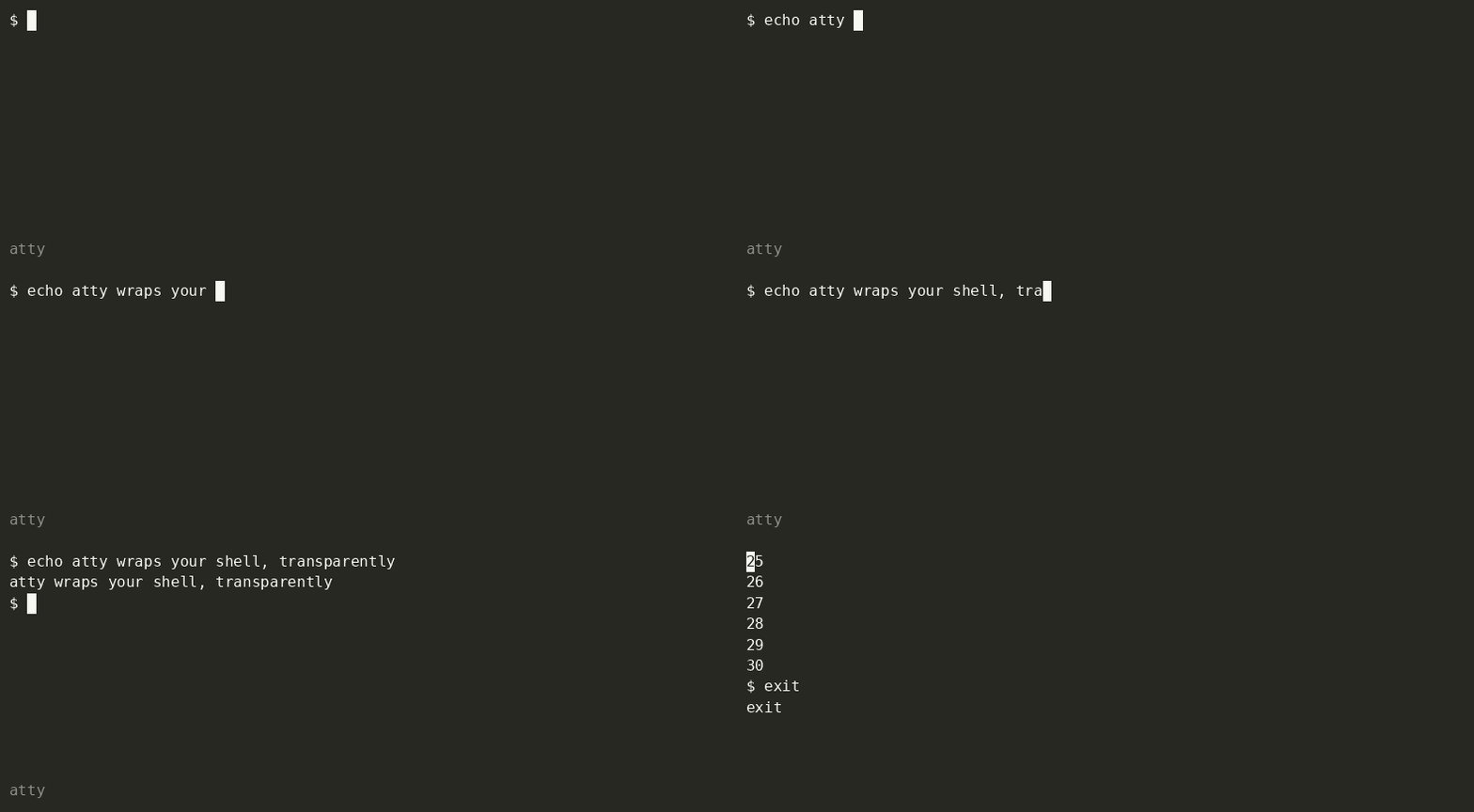
Off by default (config.statusbar.enabled = false); opt in if you
want a persistent indicator. When enabled:
- Startup: emit DECSTBM
\x1b[1;<rows-N>r(N =reserve_rows, default 3) to confine shell scrolling to rows 1..(rows-N). Set the slave PTY size accordingly viaTIOCSWINSZso the shell wraps inside the visible region. - Each render cycle (tick, keystroke, shell-output flush): the
proxy assembles a status line —
incognitoprefix if on, thenconfig.statusbar.base_text, then every module’sstatusTextsegment joined with ` │ ` — and paints it into row N inside a save-cursor / CUP-N,1 / SGR / text / sgr_reset / restore-cursor wrap so the shell’s cursor model is untouched. - SIGWINCH: reapply DECSTBM with new bounds and resize the slave winsize.
- Exit / detach: clear the reserved rows and reset DECSTBM.
The default reserve_rows = 3 layout (top → bottom):
rows - 2 :  hint / error notification
rows - 1 :  blank padding (visual breathing room)
rows     :  status text
The notification row is shared between two surfaces:
- Hint (
provideHintText→setHint) — informational text inhint_style(dim italic by default). Used for LLM explanations of injected commands and similar annotations. 30s TTL. - Error (
provideErrorText→setError) — diagnostic text inerror_style(muted red + leading ⚠ glyph). Takes precedence over hints on the same row; once the error’s 60s TTL expires a still-active hint resurfaces. The LLM module uses this for “no endpoint configured”, “HTTP 500”, “couldn’t parse response” — transparent failure instead of silent no-op.
Bumping reserve_rows to 4+ adds more blank padding above the
hint; dropping to 2 collapses hint and status onto adjacent rows
(legacy behaviour); 1 disables the hint surface entirely.
Modules participate via the optional statusText hook — see
Writing a module —
or via provideHintText / provideErrorText, the
notifications-above-the-status-bar surface.
The keymap action incognito_toggle flips a proxy-local boolean
that becomes ctx.incognito; the proxy then prepends a 🔒 segment
and gates dispatchLineCommit (no records written while on).
Bash-style leading-space is treated the same as incognito for a
single line — HISTCONTROL=ignorespace muscle memory works without
toggling.
Ctrl+Shift+I as the default binding for incognito_toggle
requires the terminal to emit a distinct sequence — classic terminal
mode collapses it to Tab. atty pushes the kitty keyboard protocol’s
disambiguate flag (\x1b[>1u) at startup so Ghostty / kitty /
foot / WezTerm send \x1b[105;6u for Ctrl+Shift+I. Terminals that
don’t support the protocol ignore the enable byte; the binding then
silently no-ops in those environments — Alt+i is bound as a
classic-encoding fallback. Disable the protocol push via
config.terminal.enable_kitty_keyboard = false if you have a reason.
CSI-u intercept. With the protocol on, the terminal sends CSI-u
sequences not just for our bound keys but for any key that gets
disambiguated (Ctrl+9, Ctrl+Shift+Right, Shift+Tab, …). The shell
doesn’t speak the protocol — if those bytes reached it, you’d see
mojibake echoed back. The proxy’s stdin handler runs keymap.isCsiU
on every read: if the input is a CSI-u sequence that didn’t match a
binding, atty translates it back to its legacy byte form via
keymap.csiUToLegacy (so Ctrl+letter, Esc, Tab, Enter, Backspace
all still reach the shell as their classic single-byte encodings)
or drops it if there’s no legacy form (Ctrl+9, etc.).
Pick list (multi-row ghost suggestions)
The inline ghost shows the single best match after the cursor. The
pick list shows up to 9 alternative matches in dim rows directly
below the prompt — fish/zsh-autosuggestions don’t have an equivalent,
but atuin’s interactive Ctrl+R does, and the visual + UX model is
borrowed from there. Opt in with ghost.list_count = N (default 0 =
off). Default key bindings: Ctrl+1..Ctrl+9 (kitty kbd) and
Esc+1..Esc+9 (legacy ESC+digit, doubles as Alt+digit fallback) pick
the Nth entry — its trailing portion (past what the user has typed)
is substituted into the input, same as ghost_accept for the inline
ghost.
Activation / deactivation is dynamic — no permanent dead space:
- On every input event the proxy asks
dispatchGhostListfor matches (first non-null wins; history walks its ring newest-first, atuin parses the worker’s multi-line response). - Want list & not active → activate: emit
\n× N (each LF scrolls the scroll region up if the prompt is near the bottom row; mid-screen they’re just cursor moves), CUU N (cursor returns to the prompt row), then\x1b[1B\x1b[1G\x1b[Jinside a save/restore wrap (the\x1b[1Gstep before the ED 0 is critical — without it, the user’s typed prefix on column 1..COL_ORIG-1 of row R+1 is left alone and stale paint leaks through). ThenpaintEntrieslays the list at relative descents. - Want list & active & cache changed → repaint: same descent
loop, no LFs. Iterates
reserved_rows, paints + EL-erases each slot so a shrinking list blanks its trailing rows. - No matches / line cleared / line uncertain & active →
deactivate: same wipe sequence as the activate “make-room” tail
(
\x1b[1B\x1b[1G\x1b[J) inside save/restore. The cursor does NOT scroll back — the prompt stays at the screen position activate floated it to, matching atuin Ctrl+R’s UX.
Why dynamic, not DECSTBM-reserved. An earlier attempt inflated
statusbar.reserve_rows by list_count so DECSTBM permanently
constrained the shell. It worked but felt “constantly spaced” at the
bottom even when nothing was shown. The LF + CUU dance gives the
same room-making behavior on demand, releases the rows when the
list goes empty, and doesn’t require DECSTBM coordination with the
statusbar’s existing reservation.
Known limitation. When the shell scrolls output past the prompt (Enter + multi-line command output), the painted list rows scroll up with the rest of the content. They reappear on the next user keystroke — at the new prompt’s row. There’s no DECSTBM constraining shell scrolling away from the list rows in this mode.
Concurrency
The proxy is single-threaded except that each module may own a background worker thread.
The Atuin module’s worker handles three jobs through one mailbox:
main thread          shared (mutex)              worker thread
───────────          ──────────────              ─────────────
onInput      ─────▶  req_buf  ───────────────▶  read latest
                     req_gen ↑                   run lookup
                                                 res_buf  ◀──── write result
                     res_gen ↑
provideGhostText ◀── read res_buf

onLineCommit ─────▶  rec_queue[tail] ────────▶  drain head FIFO
                     rec_count ↑                 atuin history start
                                                 (then maybe atuin sync
                                                  on a detached thread)
The QUERY side coalesces naturally — each new keystroke overwrites the pending request, so the worker only ever sees the most recent state. No queue, no backpressure.
The RECORD side is a bounded FIFO ring (record_queue_capacity,
default 16). Two Enter-presses arriving before the worker drains
both land in order — earlier latest-wins behaviour silently lost
the first commit. At cap, the producer drops the newest entry
(the oldest is already in flight to atuin’s local store) and
increments rec_dropped; the status bar surfaces this as
atuin (N dropped) until detach.
Periodic atuin sync runs on a detached std.Thread.spawn so
the worker never blocks on network round-trips — without that,
every record would stall the next ~5–30 seconds of queries and
the ghost would appear stuck. The final sync on detach is
joined with a timeout (sync_on_detach_timeout_ms, default 3 s)
so an interactive session’s exit doesn’t leave commits stranded
in atuin’s local store unsynced; on timeout the sync thread is
detached so process exit stays bounded.
Future work
- OSC 133 prompt-marker awareness — the shell can emit
OSC 133 ; Abefore each prompt; using that, we could throw away half of our line-state guesswork. - Atuin daemon socket — once Atuin’s IPC stabilises, swap the subprocess backend for a long-lived Unix socket.
- Bracketed-paste detection — suppress ghost text during a paste burst.
- PTY ring buffer — needed only if a future module wants to
parse fragmented ANSI sequences in
onOutput(e.g. an OSC 133 parser); core path doesn’t need it.